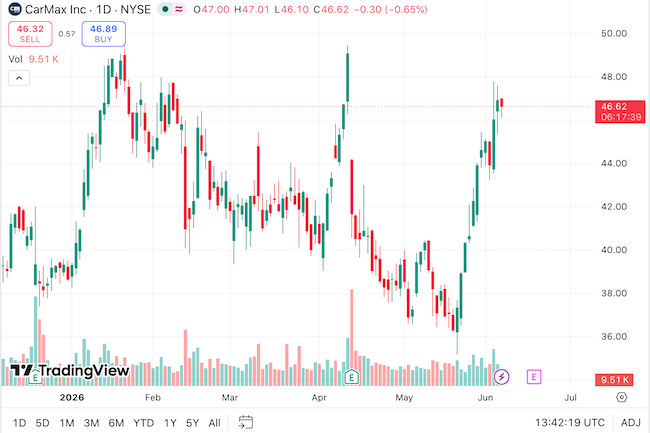
It's easy to dismiss major stock movements as Wall Street noise. But CarMax's recent rally may be signaling broader shifts in the used-vehicle market that local dealers should pay attention to.
Critical Shifts:
- Inventory acquisition is becoming the new competitive battleground. As major retailers like CarMax pursue higher sales volumes, competition for quality wholesale inventory may intensify, putting pressure on acquisition costs and dealer margins.
- Back-end profit centers are more important than ever. Dealers with strong F&I, service, and customer-retention strategies are better positioned to weather fluctuations in vehicle pricing and front-end gross profits.
- Credit conditions could reshape the used-car market. As lenders become more selective, dealers with diverse financing relationships and disciplined underwriting practices may gain a significant competitive advantage.
______________________________________________________________________
Investors aren't simply reassessing one company—they're reevaluating the outlook for the entire used-car ecosystem. For independent dealerships, BHPH operators, and franchise stores, several key themes emerging from CarMax's recent performance offer valuable insights into the challenges and opportunities shaping the industry.
1. The Volume-Over-Margin Tradeoff
One of the clearest trends in today's used-car market is the increasing pressure to balance sales volume against profitability.
Large retailers have demonstrated a willingness to use pricing as a tool to stimulate demand and accelerate inventory turnover. While these strategies can improve unit sales, they often come with thinner margins and increased pressure on overall profitability.
This dynamic highlights an important reality: higher sales volume does not necessarily translate into stronger financial performance.
What It Means for Local Dealers
National retailers can often withstand margin compression because of their scale, access to capital, and operational efficiencies. Most independent dealers do not have the same flexibility.
Competing solely on price can quickly erode profitability. Instead, local dealers may benefit from focusing on disciplined inventory acquisition, localized market knowledge, and vehicle segments where competition is less intense and margins remain healthier.
In many cases, success comes from finding inventory that larger competitors overlook rather than attempting to match their pricing strategies.
The Wholesale Ripple Effect
One consequence of CarMax's push for volume is often overlooked: its impact on wholesale inventory.
When large national retailers become more aggressive about growing unit sales, they need to acquire more vehicles. Companies such as CarMax have significant purchasing power through consumer acquisitions, trade-ins, and auction channels. As they increase their appetite for inventory, competition for desirable used vehicles can intensify across the market.
For independent dealers, that can translate into higher acquisition costs and fewer opportunities to buy clean, front-line-ready inventory at attractive margins. The challenge isn't necessarily selling vehicles—it's replacing them profitably.
The result is a growing divide between dealers that rely primarily on wholesale auctions and those that have developed alternative sourcing channels. Dealers with strong direct-to-consumer buying programs, service-lane acquisitions, referral networks, and local trade-in pipelines are often better positioned to protect margins when wholesale competition heats up.
In other words, the next competitive battleground may not be retail pricing—it's inventory acquisition. Dealers that control their sourcing strategy will have a significant advantage over those competing for the same vehicles at auction.
2. Back-End Revenue Is a Competitive Advantage
While vehicle sales remain the most visible part of the dealership business, many of the industry's strongest profit centers exist beyond the front-end transaction.
Parts, service, and Finance & Insurance (F&I) operations continue to provide stability and recurring revenue, helping dealerships weather fluctuations in vehicle pricing and inventory availability. The importance of F&I has become even more apparent as front-end margins have normalized. According to the Q4 2025 Haig Report, publicly traded dealership groups generated an average of $2,547 in F&I gross profit per retail unit—near record levels for the industry.
Industry analysts increasingly recognize that diversified revenue streams can be a major differentiator during periods of market uncertainty.
What It Means for Local Dealers
Dealerships that rely primarily on front-end vehicle margins are often more exposed to swings in wholesale prices and consumer demand.
Strengthening F&I performance, expanding service capabilities, improving customer retention, and creating long-term customer relationships can provide more consistent profitability over time.
For BHPH operators, this principle extends beyond traditional F&I products. Payment performance, customer retention, collections efficiency, and service-related revenue opportunities can all contribute to long-term profitability.
In today's environment, back-end operations are not simply supplemental revenue sources—they are strategic assets.
3. Credit Conditions Are Worth Monitoring
Financing remains a critical driver of used-vehicle sales, making credit market trends especially important for dealers.
As lenders continue to evaluate credit quality, delinquency trends, and broader economic conditions, underwriting standards may become more selective in certain segments of the market. Changes in financing availability can have a direct impact on vehicle affordability and consumer purchasing behavior.
At the same time, affordability pressures continue to build. Higher borrowing costs and extended loan terms have increased concerns about credit quality across portions of the auto-finance market. As lenders adjust to evolving risk conditions, access to financing could become a larger factor influencing vehicle sales and inventory demand.
What It Means for Local Dealers
Maintaining strong relationships with multiple lending partners can help dealerships remain flexible as market conditions evolve.
For independent dealers, that means cultivating relationships with regional banks, credit unions, and specialized finance companies. For BHPH operators, it means balancing growth opportunities with disciplined underwriting standards.
If traditional lenders become more selective, some consumers may find themselves migrating toward alternative financing channels. That could create additional opportunities for dealers serving credit-challenged customers, but it may also increase portfolio risk if underwriting discipline weakens.
Dealers should pay close attention to approval rates, funding trends, and lender participation across different credit tiers. Access to reliable financing sources may become an increasingly important competitive advantage if credit conditions tighten.
The Bottom Line
CarMax's recent rally reflects more than investor enthusiasm for a single company. It highlights several broader themes shaping the used-vehicle industry: margin pressure, increasing competition for quality inventory, the growing importance of back-end profitability, and heightened attention to credit quality.
For independent dealers, franchise stores, and BHPH operators, the takeaway is clear: focus on sustainable profitability rather than pure volume, invest in high-margin revenue streams, strengthen inventory acquisition channels, and maintain strong lending relationships.
The dealerships best positioned for long-term success will be those that protect margins, diversify revenue sources, control their inventory pipeline, and adapt to evolving financing conditions without sacrificing operational discipline.
Wall Street may be celebrating CarMax's stock performance, but the real lesson for local dealers isn't about the share price. It's about understanding the market forces driving that rally—and positioning your business to benefit from them before your competitors do.
Stay tuned for our upcoming Hot Cars to Stock Now series, where we'll spotlight the vehicles, segments, and market trends helping dealers drive stronger turns and better gross profits.