Critical Shifts:
-
Margin Compression: The 25% price hike on essential tire chemicals will directly increase wholesale tire costs, raising the average reconditioning spend per vehicle and tightening profit margins on every unit sold.
-
Inventory Volatility: With price adjustments taking effect mid-May 2026, independent dealers face a narrow window to secure current tire inventory before higher costs permeate the regional wholesale distribution networks.
-
Appraisal Sensitivity: As replacement costs rise, accurate tire assessment during trade-in appraisals becomes critical; missing a necessary tire swap could now result in a significantly higher-than-expected deduction from a deal's net profit.
___________________________________
The global automotive supply chain is bracing for a significant shift as Flexsys, a dominant chemical supplier, announced a 25% price increase on Insoluble Sulfur and 6PPD grades effective mid-May 2026. For those tracking used car market trends, this move highlights the growing auto industry inflation and the rising cost of vehicle maintenance and reconditioning. While chemical price hikes often feel like "upstream" problems for manufacturers, the reality is that the automotive aftermarket and independent auto dealers are next in line for the impact.
For the independent dealer, this isn't just a story about chemistry; it is a story about margins. Here is how the Flexsys announcement will likely hit your lot:
The Squeeze on the Service Drive: Rising Reconditioning Costs
In the used car world, "new tires" are often the primary selling point for high-mileage units. As the cost of insoluble sulfur and 6PPD increases raw material prices for manufacturers, the wholesale cost of rubber is projected to climb significantly. This creates a specific set of challenges for your back-office and service bay:
-
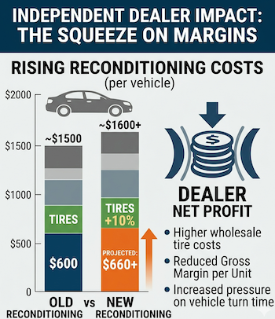
Safety First Margin Erosion: Tires have historically been a predictable expense. If your standard reconditioning budget for a sedan was $600 for rubber, that same set could soon cost $660 or more. Across 20 units a month, that’s an extra $1,200 pulled directly from your net profit.
-
Wholesale Compression: While large franchise dealerships often have national accounts with fixed pricing, independent auto dealers typically rely on local wholesale distributors who are quick to pass through manufacturer increases. The "budget-friendly" tier of tires—the lifeblood of used car reconditioning—is rapidly disappearing.
-
The EV Multiplier: As more used Electric Vehicles (EVs) hit independent lots, the stakes get higher. EVs require specialized tires with higher load ratings and lower rolling resistance. Reconditioning a used Tesla or Mustang Mach-E will now carry a significantly higher "tire tax" than its internal combustion counterpart.
-
Appraisal Accuracy: The days of "eyeballing" tires during a trade-in appraisal are over. A miscalculation of just 2/32" of tread depth could be the difference between a car that needs immediate replacement and one that can pass inspection. Your Actual Cash Value (ACV) must reflect the new market reality—not last year's prices.
The Service Drive "Sticker Shock"
 If you run a service department, your customers are about to become more price-sensitive. As the cost of 6PPD (which prevents tire cracking) and Sulfur (which ensures rubber strength) rises, the retail price of mid-to-high-tier tires will follow.
-
The Strategy: Independent dealers should consider locking in current tire inventory levels now before the May 15th price adjustments fully permeate the wholesale distribution networks.
Shifting Consumer Demand
As new tire prices climb, more used car buyers may look for vehicles that already have "fresh rubber." Conversely, savvy buyers might use older tires as a negotiation lever, knowing that a replacement set now carries a 10–15% higher premium than it did just a few months ago.
The "Green" Transition Premium
Flexsys has indicated that these price hikes are partly to fund the development of 6PPD-free alternatives—a response to environmental regulations regarding aquatic toxicity. For dealers, this signals a long-term trend: sustainable parts will be more expensive. As the industry pivots, "eco-friendly" tires may become a new selling point on your window stickers, albeit at a higher cost.
Action Plan
To help protect the bottom line, independent dealers can:
-
Audit Reconditioning Cycles: Review your current tire suppliers and ask about upcoming price protection or bulk-buy opportunities.
-
Update Appraisals: When valuing trade-ins, pay closer attention to tire condition. A car needing four new tires is a much more expensive "fix" today than it was six months ago.
-
Educate the Sales Team: Ensure your staff can explain why certain maintenance costs are rising, framing it around the industry’s shift toward higher-quality, more sustainable materials.
While a chemical price hike seems distant from the auction block, the "Flexsys Effect" is a reminder that in the auto world, everything—from the rubber on the road to the profit in your pocket—is interconnected.